
Quality Begins with the Right Raw Materials
Partnering for Progress
At Implant Surgical Company, we believe that a good surgical instrument starts with the right raw material. No matter how skilled the workmanship or advanced the machinery, the quality of the finished instrument depends greatly on the material used to make it.
As an experienced surgical instrument manufacturer, we understand that our customers expect instruments that offer reliable performance, durability, precision, and consistent quality. This is why we give special attention to the selection, inspection, and verification of raw materials before they enter our production process.
We carefully select materials according to the intended use of the product and its required mechanical properties. Our material selection and inspection procedures are designed to support our Quality Management System and the applicable requirements of ISO 13485.
We also understand that our customers need confidence in the products they purchase from us. Therefore, we focus not only on manufacturing quality instruments but also on maintaining proper material records and supporting documentation wherever required.
Our commitment is simple: use suitable materials, check them properly, and build quality into every instrument from the very beginning.
Steel We Use
Stainless steel is one of the most important materials used in surgical instrument manufacturing. However, not all stainless steel grades have the same properties. The correct grade must be selected according to the instrument’s intended use, required hardness, strength, corrosion resistance, and ability to maintain a sharp working edge.
Two commonly used groups are the AISI 300 and 400 series.
AISI 300 Series Stainless Steel
The 300 series belongs mainly to the austenitic family of stainless steels. These grades are known for their good corrosion resistance, formability, and general durability.
They are suitable for applications where corrosion resistance and ease of fabrication are important. Most common 300 series grades cannot be hardened through conventional heat treatment, making them different from martensitic stainless steels used for many cutting instruments.
AISI 400 Series Stainless Steel
The 400 series includes several types of stainless steel, including martensitic grades widely used in surgical instrument manufacturing.
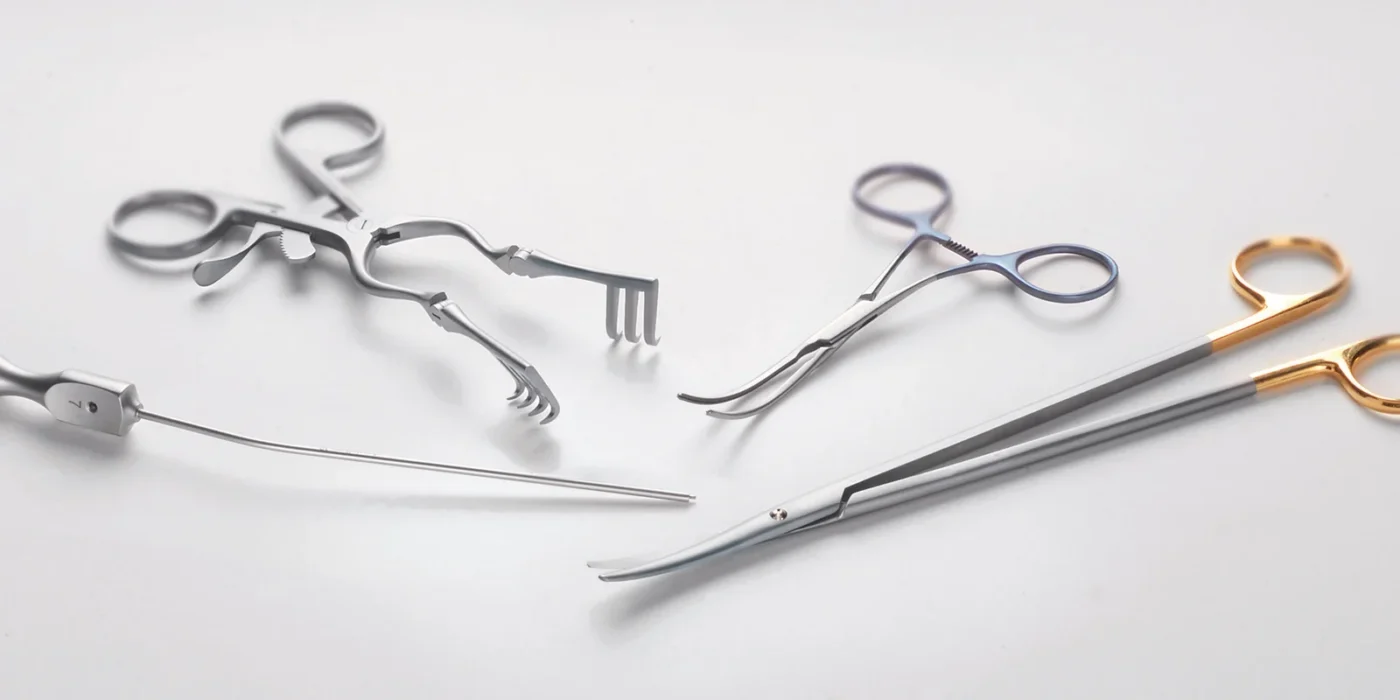
Suitable martensitic grades can be hardened and tempered through heat treatment to achieve the required hardness, strength, and edge retention. These properties make them useful for instruments such as scissors, forceps, and other products that require specific mechanical performance.
Titanium & Titanium Alloys
Titanium is another valuable material used in selected surgical instrument applications. It offers an excellent combination of low weight, high strength, and corrosion resistance.
Depending on the product requirements, titanium and suitable titanium alloys can be considered for applications where these properties are particularly beneficial.
Common titanium alloys include:
- Ti-6Al-4V: An alloy containing approximately 6% aluminium and 4% vanadium, known for its high strength-to-weight ratio.
- Ti-6Al-7Nb: An alloy containing approximately 6% aluminium and 7% niobium, used in selected medical applications where its material properties are suitable.
Titanium is also non-magnetic in its pure form and is generally well suited to demanding environments. However, magnetic behaviour and suitability for a particular medical application depend on the exact grade, product design, and intended use.
For instruments intended to undergo repeated autoclave sterilisation, the suitability of the selected material must also be considered alongside the instrument’s design, surface finish, and validated processing requirements.
At Implant Surgical Company, we select titanium or titanium alloys where they are appropriate for the product’s intended purpose and required performance.
Material Test Reports & Traceability
We believe that customers should have confidence not only in the finished product but also in the materials used to manufacture it.
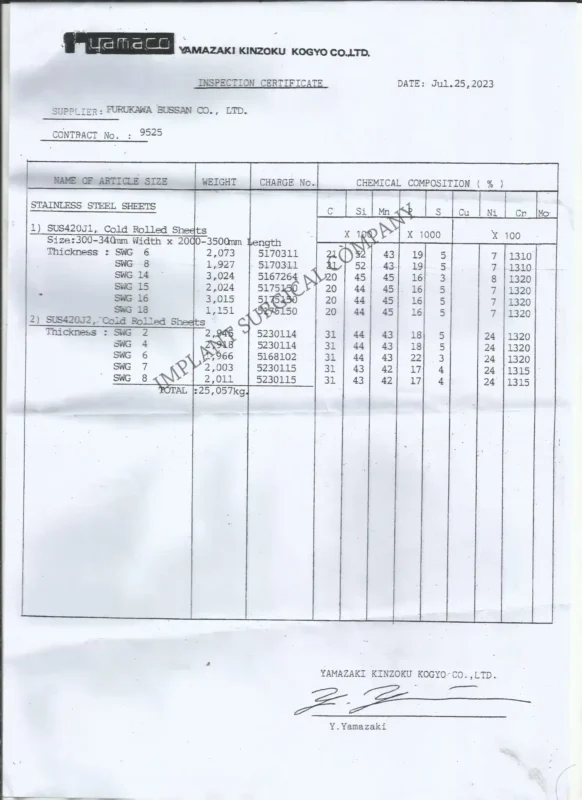
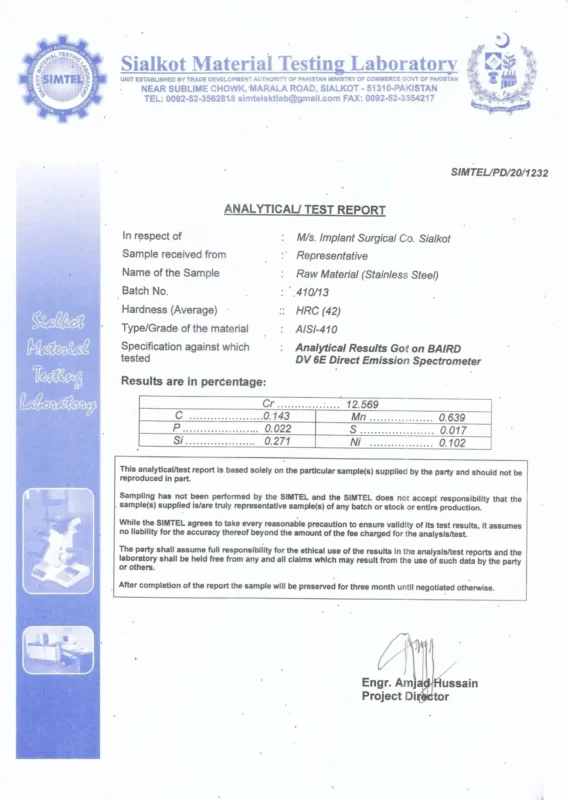
Where applicable, we obtain material certificates or test reports from our suppliers to support the verification of material composition and specified properties. For relevant stainless steel materials, we have sourced material from Japan and maintain supporting documentation for the applicable batches.
These records help us verify that the supplied material corresponds to the required grade and provide supporting information for quality checks and traceability.
stainless steel chemical composition material test report mill certificate laboratory analysis surgical instrument raw material
Example of a material composition or test report used to support material verification